
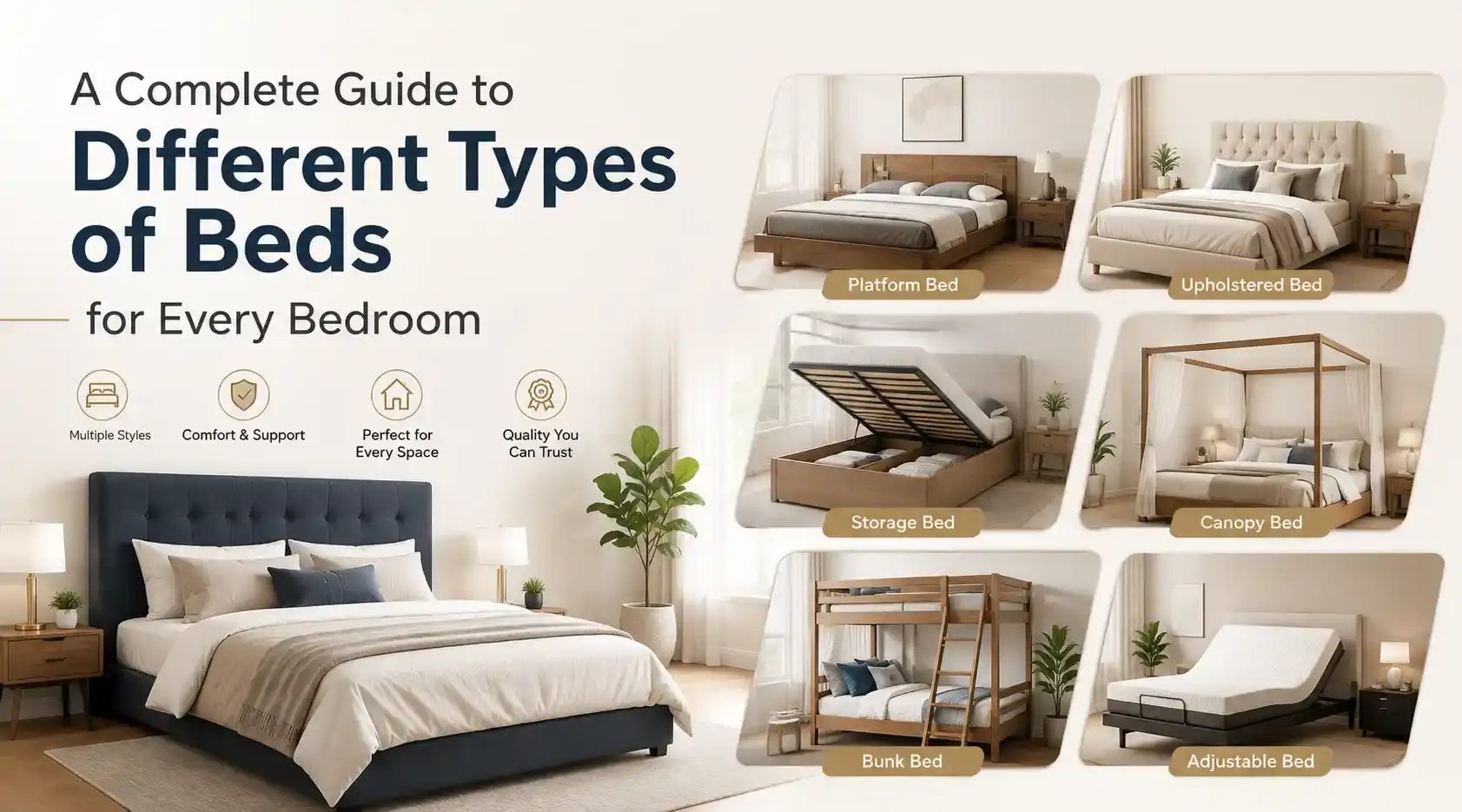
Every person looks for comfortable bedding furniture for their bedrooms. Whether it is a main bedroom, a kids' room, or a guest room, all require at least one bed for standard accommodation. Choosing the wrong bed is not just a comfort issue. It affects how the room functions, how much space you have, and, in a shared room, how well two people actually sleep.
This guide covers 12 bed types across different room categories, with actual dimensions and practical notes on who each one works for.
Before going into individual bed types, here are the standard dimensions you will encounter across most markets:
| Bed Type | Dimensions (ft) | Dimensions (cm) | Best For |
|---|---|---|---|
| Twin / Single | 6.0 x 3.0 | 183 x 91 | Kids, solo sleepers |
| Twin XL | 6.6 x 3.0 | 200 x 91 | Taller kids, college dorms |
| Full / Double | 6.0 x 4.0 | 183 x 122 | Couples in smaller rooms |
| Queen | 6.6 x 5.0 | 200 x 152 | Couples, main bedroom |
| King | 6.6 x 6.0 | 200 x 183 | Families, large rooms |
| Bunk Bed | Varies | Varies | Two kids, space-limited rooms |
| Sofa Cum Bed | Varies | Varies | Guest rooms, studio apartments |
| Storage Bed | Varies | Varies | Any room with storage shortage |
These are standard market dimensions. Actual sizes can vary slightly by manufacturer.
The main bedroom usually takes the largest bed the room can accommodate. That said, bigger is not always better. A king bed in a small room leaves no walking space, which creates a different kind of discomfort.
A double bed fits two average-sized adults, though it gives each person roughly the same width as a single bed when shared. Dimensions are 6 feet by 4 feet. It works for couples in rooms that cannot accommodate a queen without crowding the floor space. It is also a reasonable single-person bed for an adult who wants more room than a twin.
The limitation is straightforward: if two adults are both broad-shouldered, it gets tight. A couple who regularly adds a child to the bed will find it insufficient within a year or two.
At 6.6 feet by 5 feet, a queen bed gives two adults noticeably more sleeping width than a double. It is the most commonly purchased bed size for couples, largely because it fits most standard main bedrooms without taking over the room. A small family (two adults and an infant) can use it comfortably, though a toddler who moves in the night will test that.
Queen is the default recommendation for most main bedrooms unless the room is either very small (in which case a double is smarter) or very large with a family that sleeps together (in which case consider a king).
A king bed at 6.6 feet by 6 feet gives two adults a meaningful amount of individual space. Each person gets about the same width as a twin bed, which makes a noticeable difference for light sleepers disturbed by a partner's movement.
The trade-off is room footprint. A king bed needs a room that is at least 12 feet by 12 feet to leave enough walking space around it. Anything smaller and the bed starts to dominate the room in a way that feels cramped rather than luxurious.
A leather bed is not a size category. It is a frame material. Leather beds are available in double, queen, and king sizes. We separate them as a category because the material choice changes the room significantly.
Leather frames are more durable than fabric upholstered frames in most cases. They resist stains, do not trap pet hair, and are easier to wipe down. In warmer climates or rooms without climate control, the surface can feel warm in summer. In rooms with air conditioning, this is rarely an issue.
They work well in rooms going for a cleaner, more formal aesthetic. They tend to age better than fabric if maintained properly.
A storage bed has a base that functions as a drawer or lift-up compartment rather than a solid box or leg frame. The storage capacity varies by model, but most accommodate bedding, seasonal clothing, or other household items you need accessible but not daily.
The practical case for a storage bed is strong in rooms that lack a wardrobe or in apartments where every square meter counts. The visual profile is typically lower and cleaner than beds with exposed legs, which can also make a small room feel less cluttered.
One thing worth noting: lift-storage beds require clearance to open. You cannot position one directly under a low ceiling or against a wall that blocks the lift mechanism.
An adjustable bed allows the user to raise the head or foot of the mattress to different angles. They are commonly recommended for people with lower back pain, acid reflux, or circulation issues, as different elevation angles can reduce pressure on specific areas of the spine and legs.
These beds require a compatible mattress, typically memory foam or latex, since spring mattresses do not flex well. They are available in single and double configurations. The mechanism adds to the cost, and the base is heavier than a standard frame, which matters if you need to move the bed often.
Children's beds have a few factors worth thinking through separately from adult beds. Height from the floor matters for young children. Length matters because children grow. And if two children share a room, floor space becomes the real constraint.
At 6 feet by 3 feet, a twin bed is the standard for children. It gives a child enough room to sleep comfortably through most of their growth years and fits easily into rooms that cannot accommodate anything larger.
Two twin beds in a room work well for siblings. They take up more floor space than a bunk bed but give each child their own space at floor level, which some children sleep better with.
A twin XL is the same width as a standard twin but 6 inches longer, measuring 6.6 feet by 3 feet. It suits taller children or teenagers who are approaching adult height. The extra length means they can keep the same bed through late adolescence without their feet hanging off the end.
It is also a common size for college dormitories, so a child who gets a twin XL in middle school can take it with them.
A loft bed raises the sleeping surface to the height of a top bunk but leaves the area underneath open. That space typically fits a study desk, a small wardrobe, or storage shelving. In a small room, this effectively gives the child two functional zones where otherwise there would be one.
Loft beds are not suitable for very young children because of the fall risk. Most manufacturers recommend a minimum age of six, though this varies. Check the mattress height against the ceiling to ensure enough headroom above the bed.
A bunk bed stacks two mattresses vertically within a single frame footprint. For two children in a small room, it is the most space-efficient option available.
Safety rails on the upper bunk are standard but worth verifying before purchasing. The upper bunk is generally not recommended for children under six. The ladder or stair design matters for younger children as well, with stair designs being safer for kids who are still developing coordination.
Guest rooms are usually used intermittently, which changes the math on what to buy. A room that sits empty most of the year but needs to sleep two adults occasionally has different requirements than a room that gets regular use.
A sofa cum bed is a seating unit that converts into a sleeping surface. During the day, it functions as a sofa. At night, the mechanism unfolds or extends to create a flat sleeping area.
The quality of the sleeping surface on sofa cum beds varies more than on dedicated beds. Better units have a proper mattress that folds with the frame. Lower-end units use a thinner foam pad that works for a night or two but gets uncomfortable over extended stays.
For a guest room that doubles as a lounge or home office, this is a practical choice. It earns its floor space on days when there are no guests.
A daybed has a frame designed to look like a sofa or chaise from the side but accommodates a standard twin or twin XL mattress flat. Unlike a sofa cum bed, it does not convert. It sits low and long and functions as both seating and a sleeping surface without any mechanical change.
The advantage over a sofa cum bed is simplicity. There is no mechanism to fold out, nothing to maintain, and you can use a proper mattress from the start. The trade-off is that it always occupies the full footprint of a bed, even when being used as a seat.
In apartments with under 120 square feet of bedroom space, the bed choice directly affects whether the room feels livable or just functional.
A twin at 3 feet wide is the minimum footprint for a single sleeper. In a very small studio, it is sometimes the only option that leaves enough floor space for other furniture. A double at 4 feet wide is more comfortable for a single adult and still manageable in most apartment bedrooms.
A queen bed can fit in a room as small as 10 feet by 10 feet, though it leaves limited circulation space. For couples in apartments, it is usually worth the trade-off in floor space given how much better two people sleep on a queen versus a double over time.
In a studio where the bedroom and living area are the same room, a sofa cum bed or daybed is often the only arrangement that makes the space function across the day. The bed does not disappear entirely, but it reads as seating during waking hours, which changes how the space feels.
What are the main types of beds?
The main categories are twin, twin XL, full/double, queen, king, bunk, loft, storage, adjustable, leather, sofa cum bed, and daybed. These cover most configurations available across standard markets.
What is a small bed called?
A twin or single bed is the smallest standard adult sleeping surface. It measures 6 feet by 3 feet. For children under five, smaller toddler beds exist but are less common as a standalone purchase.
What is the difference between a queen and a double bed?
A queen is 6.6 feet long and 5 feet wide. A double is 6 feet long and 4 feet wide. The queen is longer and significantly wider, which makes a noticeable difference when two people share the bed.
What type of bed works best in a small room?
A twin for a single sleeper or a double for a couple. If the room is also used as a living space, a sofa cum bed or daybed recovers floor space during the day.
What is a bed with storage underneath called?
A storage bed or ottoman bed. The base either opens as a lift-up compartment or has built-in drawers on the sides.
What does bed configuration mean?
Bed configuration usually refers to the size and layout of the bed frame and mattress setup. In hotel and rental contexts, it often describes how many beds are in a room and what type they are, such as "twin configuration," meaning two single beds, or "king configuration," meaning one large bed.
What types of beds are best for two kids sharing a room?
A bunk bed is the most space-efficient option. Two separate twin beds work if floor space allows and both children prefer sleeping at ground level.
 2894625074@qq.com



 17806070028